Frequent use of air fresheners is discouraged, especially for children, pregnant women, and people with asthma, warns the magazine 60 Millions de Consommateurs. It calls for clear labeling regarding the health risks associated with these products.
The monthly magazine evaluated 20 air fresheners across five categories: incense, scented candles, passive diffusers, electric diffusers, and essential oil sprays. The tests measured pollutant emissions, including volatile organic compounds (aldehydes, aromatic hydrocarbons, terpenes), as well as combustion gases and microparticles for products intended for burning.
Incense proved to be the most harmful, with formaldehyde levels (a known carcinogen) reaching up to 102 µg/m³, well above the limits recommended by ANSES (the French Agency for Food, Environmental and Occupational Health & Safety). Air freshener sprays emit few carcinogenic substances, but some contain high levels of terpenes. As for candles, passive diffusers, and electric diffusers, they are considered less concerning, but not without risk.
The magazine calls for stricter regulations, particularly regarding incense and the solvents used in passive diffusers, as well as stricter controls on the use of terms like "purifying" or "sanitizing." Since 2017, combustible air fresheners have been required to display usage precautions, but no such requirement exists for non-combustible products. The Ministry of Health recommends ventilating rooms well during and after their use.
 Frank Verain Frank Verain
|
 25/09/2025 |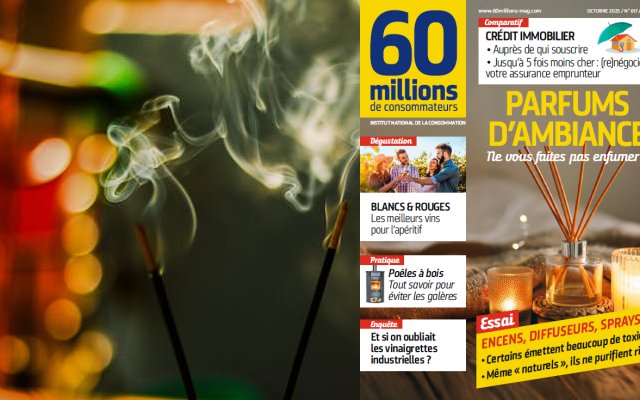















































 Anglais
 Arabic
 Deutsch
 Français
 Español
 Italien
 Português
 Russian